How to customize your racket's
weight and balance
Many pros do it, and you can, too. We explore why you might personalize your frames and provide methods to customize
your tennis racket.
The majority of today's touring pros play with personalized tennis rackets. Whether these players have their rackets customized during manufacturing or after-market, they want rackets tailor-made to their unique playing style, physique and strategic objectives. Just as the pros use customization to create the perfect weapon, you can employ the same principles and methods to gain an edge over the competition.
Weight customization: which effect?
The most common type of racket customization involves adding weight to strategic locations on a racket. This manipulates a racket's overall weight distribution, which is the primary variable for controlling how a racket will swing, feel and play. In addition to affecting things like stability, control, sweetspot location, arm-safety and power, weight distribution determines how maneuverable the racket will feel to the player (which itself determines how effectively the player can generate power and spin).
Weight customization is also used to ensure that all the rackets in a player's bag feel and play the same ("racket matching").
Whenever weight is added to a racket, it affects three major variables:
- static weight
- balance
- swingweight
Effective application of weight can also:
- increase spin potential
- improve torsional stability
- maximize ball velocity
All serious tennis players can use weight customization to manipulate these variables in a way that suits their game.
Customize your racket: what to know before
you get started
Static weight and balance point
The total mass of the racket is referred to as static weight. It's the weight you feel when you pick up the racket from the handle and are just holding it in your hand (at rest).
The balance point relates to where the majority of the racket's weight is situated.
Head light rackets have more weight in the handle than in the head. These rackets are more often used by players who can effectively use swing speed to create their desired shots.
On the flipside, head-heavy rackets are generally designed to generate power for players who can't really create much of their own power.
When discussing balance point manipulation, we find it easiest to describe it in terms of more head light or less head light (rather than "more head-heavy").
Understanding swingweight
Swingweight is the measure of dynamic inertia as the racket swings through the racket path.
As a measure of heft, the higher the swingweight, the more force has to be exerted to heave the racket. Higher swingweights provide more stability upon ball impact (resistance to twisting), which is helpful in combating high velocity shots.
With a lower swingweight the racket is more maneuverable, making it easier for the player to swing quickly; but if too low, the player may find excessive vibration and racket head twisting upon ball impact.
When customizing your racket's swingweight, the static weight, balance point and where weight is added have cause-and-effect relationships.
It's important to note that swingweight cannot be effectively reduced from a frame. The only way swingweight can be reduced is to trim the bumper guard or shorten the length of the frame; neither of which is practical. However, varying string gauge and string type can affect a racket's swingweight.
The racket customization methods we use are reversible. If you add TW customization tape to your racket, and you don't like it, you can simply remove it. You can also move it around to different locations of the hoop to experiment with different weight distribution dynamics, using the trial and error method, to ultimately find the optimal set up for your game.
Tools you'll need to customize a tennis racket
Here is a list of customization tools you'll need to personalize your tennis racket:
- Tennis Warehouse Tungsten Tape
- Postal scale: We use a model that registers to the tenth of a gram and one one-thousandth of an ounce.
- Balance board: A balance board or a dowel and a yardstick can be fashioned to measure balance point.
- Double-sided tape: The tape is helpful to reapply adhesive backing worn from moving it to different areas of the hoop with trial and error applications.
- Scissors
- Ruler
- Pen
- Snips
- Awl
- Cotton balls
- Dots
- Glue
Racket customization techniques & applications
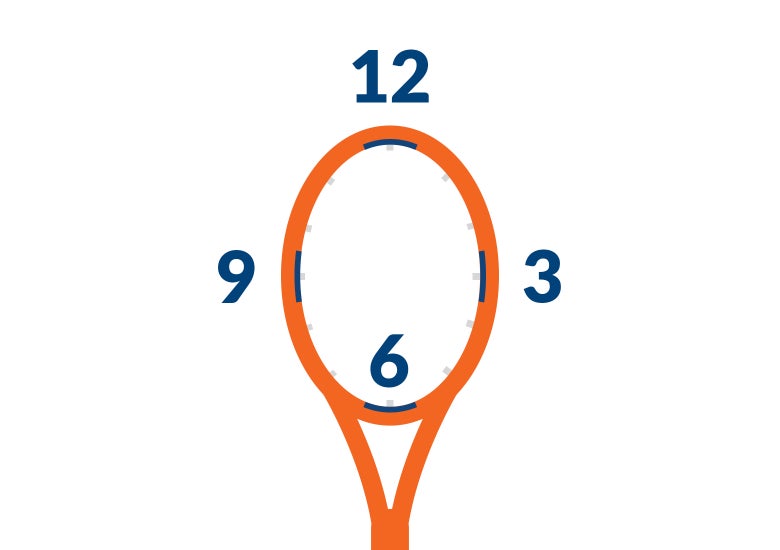
When we talk about adding weight to the racket's hoop, we usually refer to points on the racket in terms of a clock face. As demonstrated above, 12 o'clock would be the tip, 6 o'clock would be at the bridge, and so on.
Tungsten tape specifics
The TW Tungsten Tape is lead free and packaged in lengths of 20-centimeter strips. Each strip is equivalent to 2.8 grams.
Make a racket less head-light
A 20-centimeter strip cut in half, centered at 12 o'clock, makes the racket one point less head-light and increases swingweight by 10 points.
The effects of weight centered at the 12 o'clock location are: A 20 cm strip = 2.8 grams = 1 balance point (less head-light) = 10 swingweight points.
Make a racket more head-light
Conversely 2.8 grams tail-weighted to the butt cap is equal to 1 balance point more head-light, but remember, swingweight can't be reduced (unless of course you reduce the length of the racket!).
These cause-and-effect relationships are very handy when thinking in terms of counter-balancing rackets and formulating the necessary equations to customize.
We recommend adding customization tape to the inner hoop rather than under the bumper guard at least initially. When the tape is situated under the bumper guard, strings need to be cut out if the estimate is off and needs to be manipulated. Tape is much more easily adjusted if placed in the inner hoop. Tape at the 12 o'clock location of the inner hoop can be moved underneath the bumper guard, in most cases, on the next restring. When applying tape to the inner hoop of the racket, it should be placed as closely to the strings (grommets) as possible.
Customize your tennis racket to gain power
Add weight to improve stability
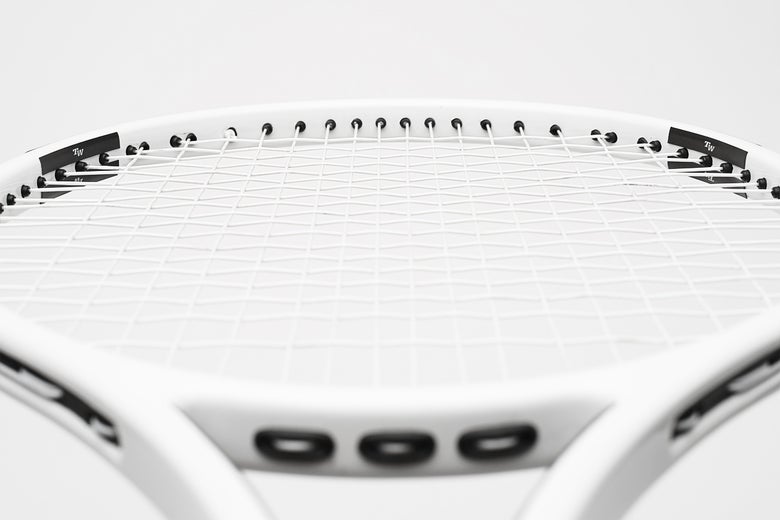
Improving stability is one of the most common reasons for adding weight to a racket. Equally adding weight to the inner hoop at the 10 and 2 o'clock locations not only makes the racket heavier, but it also helps reduce frame-twisting on off-center hits. Power potential will be increased by this application, too. We don't recommend adding weight in the upper hoop of head-heavy rackets unless counter-balancing it with weight to the handle.
Weight added to the hoop of the racket should be done in gradual amounts. Using four 5-centimeter strips at 10 and 2 is generally a good place to start. That will increase the racket's total mass by 2.8 grams, not quite one full balance point (about 3/4 balance point) less head-light with an increase of about 7 to 8 swingweight points.
Add weight to increase plow through
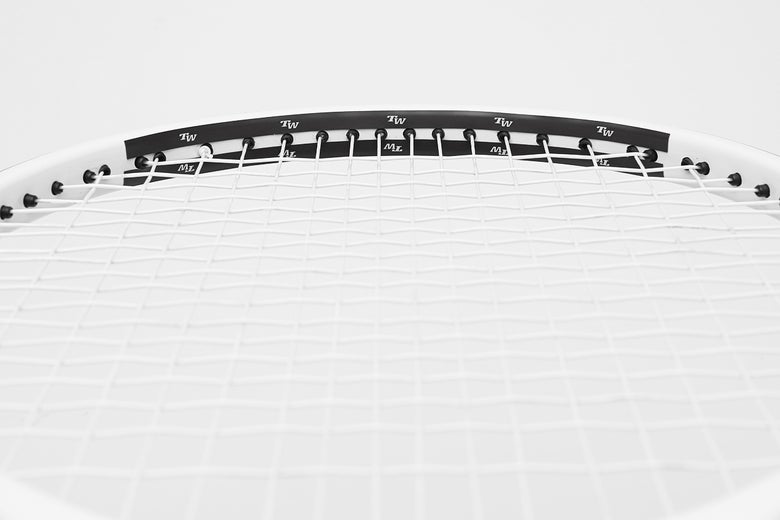
Two 20-centimeter strips of TW customization tape applied to the inner hoop, centered at the 12 o'clock location, will increase the racket's total mass by 5.6 grams, translating into 2 balance points less head-light and a 20-point jump in swingweight.
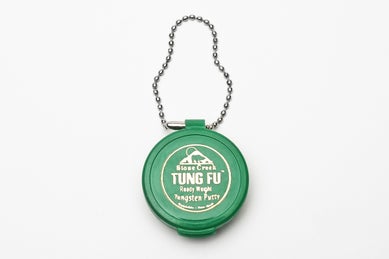
This dramatic increase to the swingweight provides greater plow through potential. Counter-balancing the racket with tail-weight is recommended with this sort of application to preserve the balance point and maintain maneuverability. In this example, placing 5.6 grams of tungsten putty in through the butt cap's trap door will move the balance point back to its original position.
In our example, we added slightly more than 11 grams in total mass to the racket. Care should be taken when adapting to an increase in weight. Players should practice every single stroke in their repertoire before unleashing strokes with maximum explosiveness. Weight added at the 12 o'clock location will also raise the sweetspot. Raising the sweetspot is advantageous to players who regularly strike the ball in the upper hoop. To evaluate a player's strike zone, find the area of the stringbed where the frictional notching is most prevalent.
Add weight to expand the sweetspot
Weight added to 3 o'clock and 9 o'clock will expand the sweetspot outward toward the weight placement. One 20-centimeter strip added on each side of the hoop (two strips total) will increase the total mass by 5.6 grams, equaling 1 balance point less head-light and increasing the swingweight 10 to 12 points. The TW tungsten tape can also be layered and is thin enough to be applied under the bumper guard if necessary.
If you are working with the Tennis Warehouse Customization Department and are requesting weight placement under the bumper guard, please provide unstrung spec targets, especially swingweight.
Increase swingweight with minimal added weight
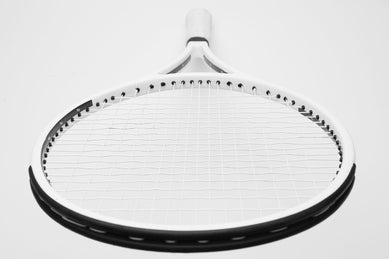
To make a racket swing heavier without substantially increasing overall weight, you can add two 5-centimeter to 7.5-centimeter strips of TW tungsten tape to the inner hoop of the racket's tip. This will result in a 5- to 7-point swingweight increase.
Add weight without changing the balance point
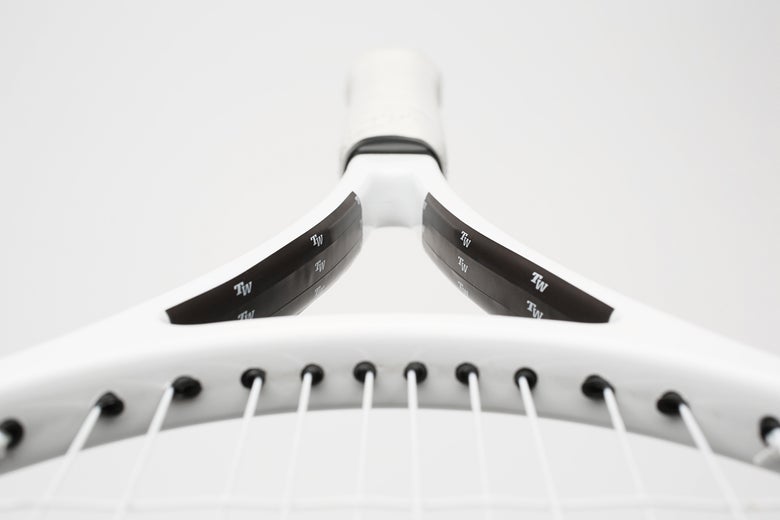
If you want to increase the racket's total mass without changing the balance point, apply the TW customization tape to the inner area of the throat of the racket. It can be cut into strips and layered or placed side-by-side. This will preserve the balance point of most rackets while increasing the racket's total mass with only a slight increase to the swingweight.
Customize your racket to make the balance more head light
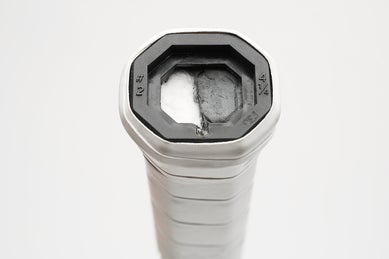
Making a racket more head light allows the player to enjoy the benefits of added weight without compromising the maneuverability.
One way to achieve this is through tail-weighting. This is fairly easy to do on rackets with trap door access through the butt cap. The staples protruding inside the handle (that hold the butt cap in place) can be used to anchor cotton balls in place. This provides a platform to pack in tungsten putty, seal it together with glue and press the trap door back into place.
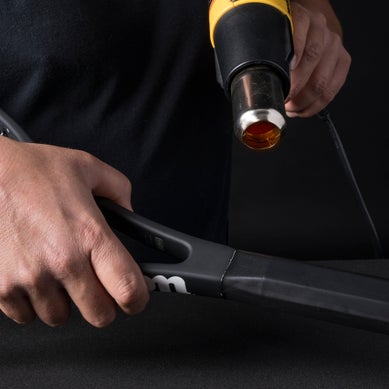
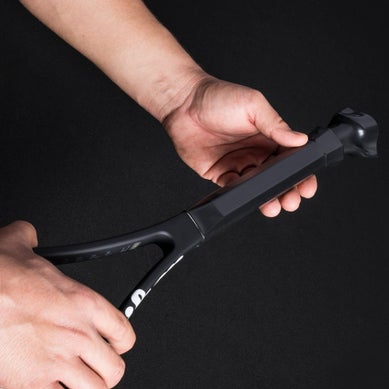
Some rackets' design prevents weight from being added inside the handle. In these cases, we've found going down a full grip size and adding a heat shrink sleeve is an effective and inexpensive way to tail-weight.
Shrink sleeves increase the grip size one full size and add 17 grams, translating into 3 points more head-light balance (and a couple points higher on swingweight points). Half-grip size heat shrink sleeves are also available and will add 8.5 grams for about 1.5 points more head-light balance.
For a tutorial, plase see Increasing Your Grip Size.
Butt cap removal
In some cases customization may require removing the butt cap. For this type of customization we recommend consulting a tennis pro shop or an experienced racket customization professional with access to the necessary tools (primarily the right kind of staple gun).
Other weight/balance factors
that need to be considered
When evaluating strung spec targets keep in mind stringbed weights vary by:
- string material type
- string pattern
- string gauge
- racket head size
- use of dampener
If unstrung, remember to factor in use of an overgrip and/or leather grip.
For years, pros have been tail-weighting their rackets, by simply replacing the stock grip with a leather grip, which is heavier than a synthetic grip.
Leather grips vary in weight but can weigh anywhere from about 5.5 grams to 11 grams more than the stock synthetic grip. As far as the effect on balance point, the leather grip versus synthetic grip variance is roughly equivalent to:
5.5 g = 1 point more head light
8.5 g = 2 points more head light
11 g = 2.5 points more head light
If you play competitive tennis or simply want the best performance from your rackets, using matching rackets is essential. Competing with two or more rackets that match in weight and balance can help you take your performance to the next level. Establishing a reference point of your racket's weight distribution specs can provide a model for future purchases. Those seeking optimal performance from their racket or further racket customization can benefit from knowing their racket's specs and how they relate to their stroke production.
Racket Customization Tool
from Tennis Warehouse University
The automated racket customization tool from Tennis Warehouse University is great for exploring possibilities. Once you plug in the "what I have" specs and the "what I want" specs, click on "customize my racket" and a diagram of weight placement options will pop up. If the specs you want aren't possible, the customization tool will let you know.
Racket Customization Services
from Tennis Warehouse Europe
Racket matching service
For a 20€ fee, Tennis Warehouse experts will sort through rackets, measuring them on the Babolat RDC (Racket Diagnostic Center), to find you a matching pair (closest values).
A matching pair is defined as two (or more) rackets chosen from a random set that "match to each other" in static weight, balance point and swingweight. Once sorted, the racket's unstrung specs are labeled and affixed to the racket's handle packaging for customers to retain.
The service fee covers the cost of handling, measuring and sorting rackets. The fee is not contingent upon finding a match and is a non-refundable service fee.
Precision racket customization
The service fee for in house TW racket customization is 40€ per racket plus the cost of the necessary materials. An updated order is submitted for customer confirmation with the materials fees in place before the work is begun. We no longer use Lead in racket customization.
For more information regarding Tennis Warehouse racket customization fees or racket matching service details, please contact our Customer Service Department at +44 (0) 844 4990 807 or email information.en@tenniswarehouse-europe.com.